Filed under: Strategies
Disinformation and epistemic trust for autistic people: WTF and How to Cope
first published:
Disinformation leads to sensory overload. Why? How? Send Help?
Quoting this article? Don't forget the citation.
Looking for the more interactive Autistic PhD community? fb page. No Meta? Newsletter or bluesky. Want my help? Get that here. Something else? Contact us.
There will be a LOT of disinformation and propaganda in the coming days and beyond. Everything is already so hard for too many people. And for autistic people, disinformation can be especially stressful.
Why can disinformation be even more stressful for autistic people?
For me, I tend to rely on sensory data as evidence of what’s true or real. I “look, listen, and feel” in order to know what’s valid and true. Autistic people often experience differences in sensory processing and perception, which can lead to sensory overload in some situations and make the world either intense or confusing in any given moment.
This process of checking out my thoughts, and collecting an ever-growing, bottomless pit of empirical evidence, is extremely valuable to me as an autistic thinker. This is a big reason why I’m such a thorough researcher: data comforts me with the realities of valid observations of things amidst an otherwise wholly chaotic social world.
Disinformation is wrong information shared with the intent to mislead people, and propaganda is any information (correct or not) shared with the intent to persuade people. We can think of disinformation as a subset of propaganda.
While all propaganda is shared with the intent to persuade those who receive it, some propaganda is based on correct, real, accurate information being shared to persuade people. For example, maybe an animal shelter shares authentic, emotionally compelling photos of adorable puppies they have just rescued in order to encourage donations and get folks to adopt the puppies into their homes. That’s propaganda too, by definition.
Does that make sense? The exact terms don’t really matter except to clarify the scope of this article. Here, we’re talking about disinformation, and we’re doing so in the context of how our present sociopolitical context is absolute mindfuckery for autistic adults. Let’s do this.
We can be looking right up at the perfectly blue sky at midday, whilst they’re saying that the sky is jet black because the sun turned into a blackhole and unalived itself while we were sleeping, and that the sun did this because of some certain subgroup of the population that always hated the sun. (Yes it’s a ridiculous illustration. Please just go with it.)
The stress that results from this mess can get compounded as messaging repeatedly insists that the sky above us right now is not blue, and that whatever else we are seeing, hearing, or feeling is not real.
It’s hard. These onslaughts of attacks to our understanding of the world can make us question our own perceptions (btw perception is the process by which the brain makes meaning from sensory data that comes into our brain via our eyes, ears, skin, taste buds, etc.).
Who is trustworthy? Can we trust anyone? How do you determine this? For me, I tend to trust any given person in a knowledge-based sense, which leads to me having a very high confidence in my own trust. Put differently, I’m not a “gut instinct” kind of autistic person. Instead, it’s like I’ve “vetted” a person and ultimately determined them to be worthy of my trust.
But as some autistic adults describe difficulties recognizing manipulative behavior (Pearson et al., 2022; Zhao et al., 2025), I believe that when trust is broken for any of us, the emotional impact can be especially devastating. More Big Feelings, painful ones. And the resulting emotional dysregulation can substantially influence our daily living.
Of course, more research is needed to better understand how these patterns of experiences apply across the spectrum (I had to do that, sorry). Also please note that I’m not getting into the question of whether autistic people are more or less susceptible to disinformation. That’s a whole other conversation for another day.

What is epistemic trust?
For our purposes, epistemic trust is the faith a person places in communicated information, and epistemic mistrust or epistemic distrust is suspicion in communicated knowledge (Li et al., 2023; McGraw, 2015). It’s subjective, it can vary, and it’s essentially the confidence we believe that we can place in the integrity of another person.
The term for the crisis that results from disinformation is epistemic mistrust (or, more precisely, a lack of epistemic trust). This construct is from sociology and social epistemology as I know it. I do think it began with philosophers, who tend to look into trust as epistemic injustice. And more recently, developmental psychologists get into it, and they’re mostly considering the process of how children grow in their capacity to discern what and who can be trusted. The vocabulary word for that branch of study is selective trust.
When previously-trusted sources contradict what our senses tell us? Yeah, that can cause the kind of distress that makes some of us literally spin. And nobody’s brain can just remain calm when there’s as much gaslighting and denial of reality as we have swirling out there in the wild of the current moment of human history.
How to cope with the midfuckery of disinformation?
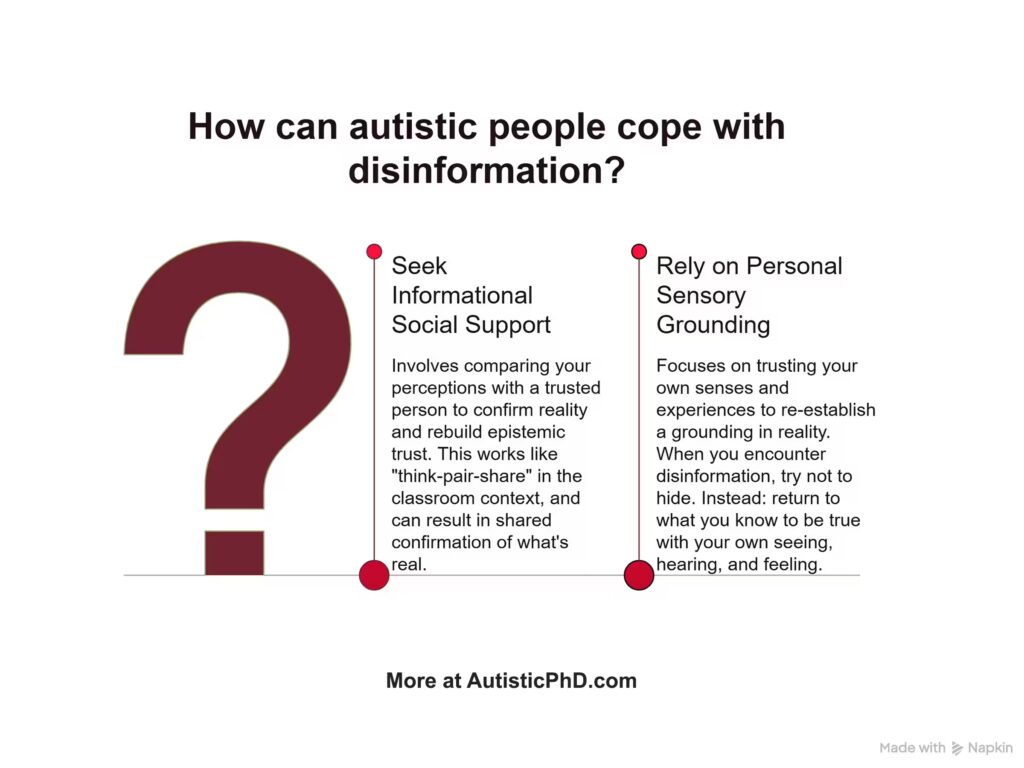
I’d just like to share one viable coping strategy for this type of stress, something based on informational social support, or getting some good ol’ knowledgeable, friendly advice. It’s a specific type of social support, which is broadly known to improve quality of life for autistic people across domains (Charlton et al., 2022).
How this works is that you need to find a trusted person with whom you can compare perceptions in good faith. Pick somebody who hasn’t violated your trust, and in whose integrity you still have faith. For me, this person is usually my spouse, Rachael the Beloved. Other good options can include a trusted teacher, coworker, therapist, or friend who gets you.

Side note for teachers: This is basically a think-pair-share activity: first each will think it through for themselves, then they will pair up to check for understanding, and lastly there is some sort of sharing of what has been confirmed as real.
Oversimplified example:
- Me: _____ never said _____, right?
- Them: Correct.
- Me: And the justification for _____ is fabricated, right? ____ never did _____?
- Them: Yes.
Go through it together until you’ve adequately confirmed what’s real and what’s not. Such an exchange can help you regain confidence in your own sensory grounding. What you’re also doing is rebuilding epistemic trust, that confidence in the integrity of another person’s knowledge.

What you see, hear, and feel is real. And you’re not alone.
Want to discuss this topic?
*There is this post on bluesky and this thread on facebook and this post on linkedin*
References
Charlton, Rebecca A., Goldie A. McQuaid, and Gregory L. Wallace. 2022. “Social Support and Links to Quality of Life Among Middle-aged and Older Autistic Adults. Autism, 27(1), 92-104. https://doi.org/10.1177/13623613221081917
Li, Elizabeth, Chloe Campbell, Nick Midgley, and Patrick Luyten. 2023. “Epistemic Trust: A Comprehensive Review of Empirical Insights and Implications for Developmental Psychopathology”. Research in Psychotherapy: Psychopathology, Process and Outcome, 26 (3):704. https://doi.org/10.4081/ripppo.2023.704
McCraw, Benjamin W. 2015. “The Nature of Epistemic Trust.” Social Epistemology 29 (4): 413–30. https://doi.org/10.1080/02691728.2014.971907
Pearson, Amy, Jon Rees, and Samantha Forster. 2022. “‘This Was Just How This Friendship Worked’: Experiences of Interpersonal Victimization Among Autistic Adults.” Autism in Adulthood, 4(2): 141-150. https://doi.org/10.1089/aut.2021.0035
Zhao, Xudong, Zhen Cao, Xuehua Xu, Xintong Li, Aijia Xu, and Wendian Shi. 2025. “Connection between autistic traits, self-esteem, and interpersonal trust: A distinct separation of implicit and explicit components.” Research in Autism, 125: 202605. https://doi.org/10.1016/j.reia.2025.202605
Citing this Article
MLA 9:
Sanborne, Erika. “Disinformation And Epistemic Trust For Autistic People: Wtf And How To Cope”. Autistic PhD, Erika Sanborne Media LLC, 18 October 2025, https://autisticphd.com/theblog/disinformation-and-autistic-coping/.
APA 7:
Sanborne, E. (2025, October 18). Disinformation and epistemic trust for autistic people: Wtf and How to cope. Autistic PhD - Erika Sanborne Media LLC. https://autisticphd.com/theblog/disinformation-and-autistic-coping/
Chicago 19 (A–D):
Sanborne, Erika. 2025. “Disinformation And Epistemic Trust For Autistic People: Wtf And How To Cope”. Autistic PhD, October 18. https://autisticphd.com/theblog/disinformation-and-autistic-coping/

by Erika Sanborne
Autistic, award-winning educator, researcher and founder of Autistic PhD | Meet the author.