Filed under: Teaching
Autistic Faculty Tenure Review: Navigating Promotion, Renewal, and Evaluation in General
first published:
Autistic faculty at pre-tenure and tenure review need to clarify feedback, request reasonable accommodations, and protect their rights.
Quoting this article? Don't forget the citation.
Looking for the more interactive Autistic PhD community? fb page. No Meta? Newsletter or bluesky. Want my help? Get that here. Something else? Contact us.
Nobody in academia is doing great right now. Autistic faculty are trying to understand what is expected of them and do their jobs well, and do you know what? Being evaluated fairly would help all of that go more smoothly.
Pre-tenure review, tenure review, even post-tenure review and the related faculty assessment processes can be stressful even for the most privileged and supported faculty. These things are brutal. For autistic faculty, the tenure review process can be especially stressful.
And too many aspects of these review processes rely on things that autistic people can struggle with, such as understanding the nature of what’s expected of them for starters.
In the words of my former Italian neighbor, “It’s a-no easy!”
There’s a lot to unpack within faculty reviews and informal critiques. In this article, I some practical strategies for getting yourself oriented and moving toward a clearer and fairer evaluation. Because you know what? When the autistic faculty person understands what is specifically required of them, they will strive to do those things. Period. Communication is a two-way street as the saying goes, and it may be left to the autistic faculty member to sort out the unclear communication coming at them from the institution.
The goal here is to help the autistic faculty member stay employed, to help them meet the expectations of their role. This requires the institution to evaluate them more accurately and convey feedback and expectations more clearly. It would also be great for institutional leadership to recognize that some problems might be a result of some institutional ambiguity, as well as some disability-related barriers.
In the best case, the clarification of communication helps everyone get onto the same page, and the autistic faculty person to thrive (American Association of University Professors [AAUP], 1999/2016; Equal Employment Opportunity Commission [EEOC], 2002, 2008).
If you are in crisis mode, breathe.
Let’s assume you have received some type of feedback that is concerning. Now you need to figure out what to do before a manageable problem turns into something much bigger than it should be.
It’s worth mentioning up top here that people might still refer to autistic communication as if it is a one-way deficit. That is not a very good description of what many autistic academics are actually dealing with. A more accurate framing might be that there is a communication mismatch between the autistic employee and the representatives communicating on behalf of their employer.
If you have never heard of it, the double empathy problem is relevant (Minton, 2012). In essence, that theory argues that difficulties in understanding between autistic people and non-autistic people are relational and mutual, as opposed to a one-sided deficit on the part of the autistic person.
If we can accept this as true, then it’s strange that autistic children have to be taught how to communicate in non-autistic ways, while non-autistic children are affirmed and not challenged to do the same. I simply invite the reader to notice that this is weird.
So too it goes in the grown-up world, that autistic people are typically deemed to have deficits when they merely differ. Things like figurative language and general fast-talking verbal exchanges can all vary across people, and many autistic people might find those demands harder to navigate, extra so when expectations are implicit rather than explicit.
Masking those communication differences can be additionally exhausting. When under stress, masking can become hard to sustain, which can then lead to being misunderstood as being blunt, or evasive, having poor judgment, or being unresponsive. Burnout is a risk at that point.
Ideally, everyone could live and work in environments that foster mutual understanding across communication styles and formats. Alas, we’re far from there, and so I return to this write-up on how autistic faculty can cope with what’s often this exact issue of a lack of mutual understanding across communication formats and styles, discussed here in the context of faculty reviews related to the tenure process and remediation.
In faculty review situations, these social misunderstandings can get linked to formal employment categories. A department may say that an autistic faculty person “struggles to communicate effectively in their service work” when what is actually happening is a mismatch around how literal language is used, coupled with stressful meeting structures, inferencing demands, and/or the pervasive expectation that everyone can naturally decode non-autistic workplace subtext.
It is wild what institutions sometimes expect of us, truly, and the burdens they are wholly unaware of even introducing. If I had a magic wand, I would help all involved parties to recognize and appreciate these differences, and to recognize that with the right supports, an autistic faculty person might just be amazing to work with, once you’re all on the same page.
Side note: I find it helpful to sometimes suggest the parallel experience of having a faculty member whose first language is not English (in the U.S. context). We all have had such colleagues, right? They’re great, but what can happen sometimes is that they “just don’t get it” when something is said. How does your department deal with supporting that person? If I had to guess, I’d say that someone clarifies the in-group speak or other interaction or directive that the second language learner didn’t initially understand. At minimum, if I may make a suggestion, please offer something like this to your autistic colleague.
Okay. What type of feedback or review stage are you at?
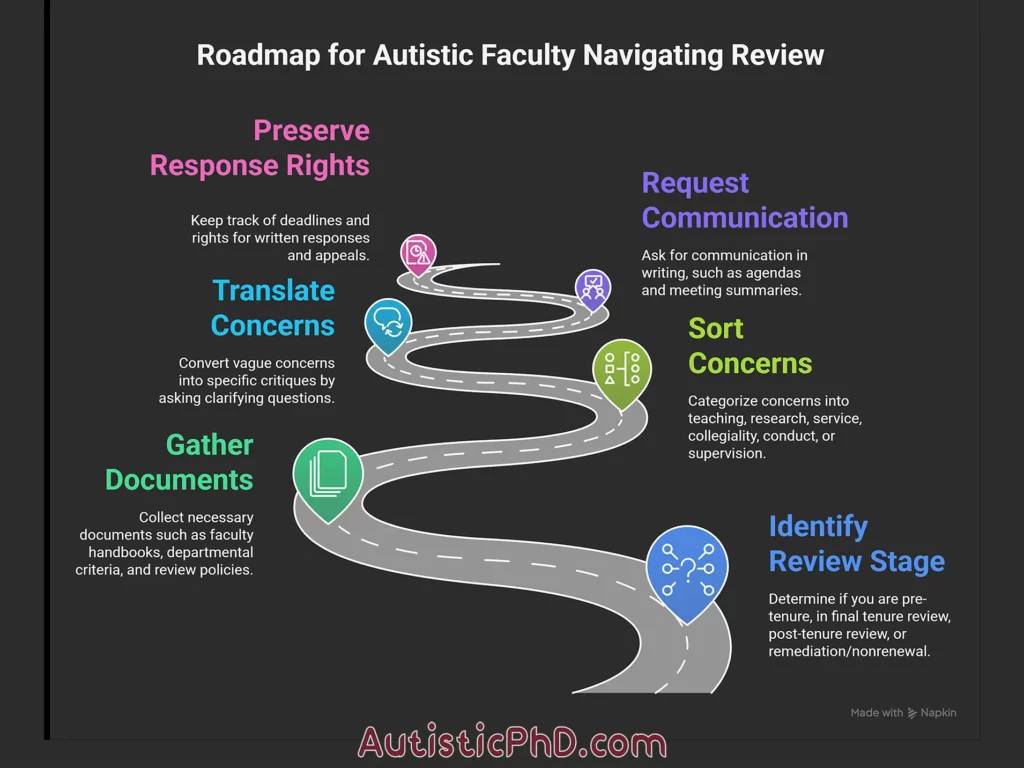
The first step in an autistic faculty tenure review situation is to identify what review process is actually happening. Obviously if it’s something like your 3-year pre-tenure review, or your final tenure review, you probably know that. But sometimes a review can occur and you’re not sure what it is and why it’s happening. So, start with orienting yourself: what exactly is the current process?
Pre-tenure review?
This is often a third-year or mid-probationary review. Pre-tenure review often uses the same broad categories as later tenure reviews, and it is meant to assess trajectory, strengths and weaknesses, and needed improvements in a faculty development sense. It’s not supposed to be punitive but instructive.
In general, pre-tenure reviews look at the triumvirate of (1) teaching, (2) scholarship or research, and (3) service. Institutions and departments sometimes add to this with other categories, and the importance of each will vary. Then there’s generally a review by a committee, chair, dean, or another authorized body, and there’s often a self-evaluation, and probably a stated plan for your ongoing research agenda.
Final tenure review?
Older concerns from pre-tenure reviews can come back and get repeated here, acting like wholly settled facts, even if they were never especially clear or they were tied to circumstances that have changed.
Post-tenure review?
I’m mostly going to gloss over this particular faculty review, because I abhor how often it’s used as an administrative or disciplinary process, instead of the “faculty development” process it supposedly is.
The American Association of University Professors (AAUP) agrees that “periodic formal institutional evaluation of each post-probationary faculty member would bring scant benefit, would incur unacceptable costs, not only in money and time but also in dampening of creativity and of collegial relationships, and would threaten academic freedom” (AAUP, 1999/2025, p.1).
So. If you’re at this point then the same general advice I’m suggesting throughout this article applies to you. Just note that I’m not adding any PTR specifics.
In some settings, post-tenure review is fairly standard. Elsewhere, it can feel much more punitive. Institutions vary widely, and in some states the broader policy climate has made PTR more managerial and more consequential (AAUP, 1999/2025).
Remediation, nonrenewal, or discipline?
If you are already in remediation, or in nonrenewal or a conduct process, this is probably a matter for employment lawyers. Your rights as an employee, including possible rights under collective bargaining, and addressing rights as an employee with disabilities, are all important here (AAUP, 2009; EEOC, 2002). Also reach out to your union rep, ideally within your department, for their guidance.
Gather the docs for your faculty review.
Universities often require each unit to maintain written criteria for tenure evaluation. At the University of Minnesota, for example, policy explicitly requires each unit to specify the criteria and indices used to evaluate candidates within their unit. At UMass Amherst, tenure and promotion guidance points faculty to the collective bargaining agreement, the academic personnel policy, and annual provost memos as key materials (University of Minnesota, 2025; University of Massachusetts Amherst, 2024).
Whatever. Find your institution’s list. Yes, it will be tedious. Consider it a checklist and start collecting and sorting.
In general, faculty need to collect these things
- faculty handbook
- department and school promotion and tenure criteria
- any unit-specific criteria statement
- collective bargaining agreement, if you are in the union
- all annual review letters
- accommodation policy for employees
- grievance and appeal procedures
- provost or faculty affairs memos for the relevant review year
- any letters, notices, or memos already received
If you are pre-tenure, add
- pre-tenure or third-year review policy
- third-year or mid-probationary review timeline
- dossier instructions, if applicable
- self-assessment instructions
- mentoring or progress review notes already on file
If you are in final tenure review, add
- full dossier checklist
- external review procedures
- criteria for tenure and promotion
- all prior annual and pre-tenure materials
- rules on written responses
If you are in remediation or discipline, add
- warning letters (including by email)
- any Performance Improvement Plan (PIP) documents
- conduct policies
- hearing or appeal rules
Sort their concerns into buckets.
Before responding to review or critique, sort each concern into the category where the institution seems to be placing it. This is one of the most useful things you can do, because it helps bring that needed clarity.
Common buckets are:
- teaching
- research or scholarship
- service
- sometimes other things, like collegiality, conduct, supervisory or administrative communication
I mean, an alleged problem with teaching needs a different response than something they’re saying is a problem with service. Once the concern is placed in a category, it becomes easier to begin zooming in to discern what is actually being evaluated or critiqued, and what kind of clarification or accommodation might help.
Translate all vague concerns into very specific critiques
Look. This is where some toxic work environments can become plainly apparent to the autistic faculty person initially at a loss about why they’re receiving negative feedback.
Some words to look out for are things like collegiality or civility, fit, friendliness, tone, responsiveness. You might also see dings to your professionalism or service behavior, and they might just say you have communication problems.
AAUP has strived to convey how collegiality in particular should not be a part of any faculty review process. As they warn of its misuse, they caution that collegiality ratings can be used to enact discrimination, among other things (AAUP, 1999/2016). This aspect of faculty review can be especially relevant to autistic faculty when communication differences are being deemed as professional deficiencies.
This is worth spelling out, I think. If the concern is described as:
- communication issues
- lack of collegiality
- poor fit
- unprofessional
- difficult colleague
- unfriendly
Then the next thing you need to do is to insist the institution make their critique a concrete one, and one that’s linked to published job requirements. Do this by asking questions, ideally in writing. Ask things like:
- What exactly happened?
- When did it happen?
- Who was involved?
- Had this expectation been written somewhere I should have seen?
- Is this issue more of an unstated or implied preference within the department?
- Was figurative language involved?
- Was there a written follow-up?
- What would a successful version of that interaction have looked like, specifically?
- Is this about an essential function of the job, or about an informal departmental preference?
- Was the concern placed under teaching, research, service, or some more informal collegiality judgment?
What are reasonable accommodations for autistic faculty?
Written communication is not only a support strategy for autistic faculty, but also a job-protection strategy. Reasonable accommodations for autistic faculty often involve more written communication, and more explicit expectations.
Try thinking about what would help you understand and meet expectations, and then frame those needs in relation to actual job duties and barriers.
It can often come down to clarity for autistic faculty, and that often means written communication of things not otherwise written down at all.
Some useful examples include:
- advance agendas for departmental, supervisory, and mentoring meetings
- written follow-up after meetings, especially focused on your role expectations and action items (this is my own personal #1 favorite accommodation in academia, and the suggestion of it has been a gift to many over the years). I plan to write a separate article on this invaluable strategy and when I do I’ll link it here. But please, for now, do consider this specific accommodation for neurodivergent faculty.
- permission to respond to feedback or complex concerns in writing rather than right in the moment verbally
- explicit deadlines and priority ranking when multiple tasks are assigned or implied
- written summaries of concerns
- structured appointment systems for office hours (this is my second most favorite accommodation in academia, and I should write this up on its own as well; I will link when it’s out)
- hybrid or virtual meeting participation where feasible
- modified supervisory communication methods
These things help with clarity of expectations, and they also create a very helpful record for any future reviews. See that? It’s another instance where accommodation strategy becomes very practical.
It is also important to remember that accommodations are generally not retroactive. Under EEOC, an employee can request accommodation at any time. The request does not have to use magic words or be made all on your own. A representative can request accommodations on the employee’s behalf. “Yes, a family member, friend, health professional, or other representative may request a reasonable accommodation on behalf of an individual with a disability” (EEOC, 2002).
If self-advocacy is hard, the request can still be made through a trusted someone who helps translate your distress into a concrete work-barrier statement. At the same time, it is still important to check with your institution’s employee-accommodation procedures and follow the correct channels.
Accommodations are usually forward-looking. They can help improve processes and evaluations in the future, but they do not usually require an institution to remove performance consequences that were already assigned before the accommodation request (EEOC, 2002, 2008).
Some pressure points for autistic faculty in review
Teaching feedback and ambiguity
Teaching reviews include student evaluations. They can also be about how you receive feedback, how you respond to supervisory input, how you (seem to) interpret implied expectations, and how you negotiate the unpredictability of a classroom context.
Suppose that feedback from the department chair is mostly verbal, with lots of indirect or figurative descriptions of expectations. An autistic faculty member can end up being judged on perceived miscommunications rather than on teaching, even under the heading of teaching.
In such a situation, altered supervisory methods can help. EEOC guidance recognizes that reasonable accommodation can include modifications in how workplace instructions and supervision are handled, as long as essential job functions are still being met (EEOC, 2002). So if you’ve received this type of critique, here is a possible accommodation to request.
Scholarship pipeline and executive-function load
A faculty member could be the best researcher and still struggle with how their institution structures productivity. There are many moving parts in the scholarship or research manuscript pipelines, for example, and that’s not even getting into grant proposals and other funding acquisitions.
Readers may also be interested in learning more about What is bottom up thinking in autism?
Then of course there’s conference participation and leadership, co-authorship hurdles (oh my gosh), informal mentoring and more. All of this relies on executive function that excels in prioritization and a sort of tolerance for shifting expectations that some refer to as flexibility.
For many neurodivergent faculty, those demands can be support needs, and they can benefit from formal support (accommodations).
So, think it through if this is a pressure point for you. Would you benefit from more written priorities lists from supervisors and co-authors? Can some research team meetings be online instead of in-person, if this helps you?
Service and committee communication
Service is where social and communication style differences can certainly be mistaken for something else. Committee work often happens where fast group talking takes place. We also have to read the room and know when an attitude shift occurred despite nobody mentioning it. And it’s decidedly common for vague, informal requests to dominate a committee meeting.
For the reader who’s never attended a committee meeting, something like this can be heard at some point during most meetings: “Does someone want to take out the trash?”
Look. Nobody wants to take out the trash. Despite that reality, several may volunteer. Why? This is a vague ask, additionally using an informal request about someone who may “want to” complete it.
And if your committee meeting doesn’t ask for exactly that, they will ask whether someone “wants to draft our positionality statement” or “wants to head up a subcommittee” on something else. Pretty much nobody wants to do any of this.
It doesn’t necessarily mean that an autistic faculty person cannot meet service requirements. It does mean that a relevant accommodation could be used here, because you know what? 100% of the autistic faculty I’ve ever met would gladly accept just being told what to do in this instance, rather than guessing when they’re supposed to pretend to want to do a thing nobody wants to do, for example.
If your faculty review includes assessment of your service work, keep an eye out for subjective, informal, and imprecise words about your time spent on those committees.
If you’re just out here acting like you never “want” to take out the trash, mostly because you don’t understand the rules of that particular game of pretend, hopefully you can fashion a simple accommodation that supports your completing service obligations, and additionally frees up the emotional labor you’ve been spending worrying about how and when you need to pretend to like taking out the trash.
Self-presentation in review materials and meetings
We’re regularly asked to self-evaluate. An autistic faculty person might undersell their accomplishments as compared to how non-autistic faculty complete the same self-evaluation. This can happen when we answer too literally or are unaware of the hidden curriculum that suggests a certain type of more strategic response.
This is a pretty important pressure point, because the committee reviewing your materials might read your self-evaluation first. This can set the tone, so to speak, for how they interpret all the rest of it.
The accommodation I would suggest for this is to find a trusted senior colleague and ask them to read your first draft of your self-evaluation. Ask them to tell you how it reads. They know you, so also ask them if you are underselling yourself. In short, ask for their help in revising your draft so that it reflects your honest self-evaluation within the constraints of what is expected for this. Push for clarity, revise, and then ask the trusted senior colleague to read your final before submitting. Then buy them a coffee.
Preserve your response and appeal rights
Keep track of:
- deadlines for written responses
- grievance deadlines
- appeal deadlines
- union timelines
- rights to submit clarification or rebuttal
- rights to representation, if applicable
Yes, you really should save every single letter and email and respond within the allowed window. Keep a dated file of concerns and responses and never rely on only verbal promises.
Review for a faculty person with disabilities involves both employment processes and disability processes. Depending on your institution, the key route may involve faculty affairs, a dean, an ADA coordinator, a union, an internal appeals body and others. The AAUP has noted that faculty handbooks can function as enforceable contracts depending on the state and institutional context (AAUP, 2009).
That means an autistic faculty member may need help and support for both the disability process and the faculty process at the same time.
Tl;dr on support for autistic faculty
Most autistic faculty are simply trying to understand what is expected of them so that they can do their jobs well.
A lot of the struggles faced by autistic faculty boil down to a misunderstanding of expectations. Institutions can communicate with a startling dearth of precision when it comes to their expectations, and it might be up to the autistic faculty person to request the clarifications they need in order to satisfy their employer’s desires.
If you’ve received negative feedback, gather relevant policies and documents, ask the questions that will clarify what is actually being criticized, and then consider requesting the accommodations and process supports that fit the situation and support your thriving in this place.
Reasonable accommodations for autistic faculty can reduce ambiguity and improve the fairness of review processes.
I know this is hard. I am rooting for you.
Want to discuss this topic?
* There is this post on bluesky and this thread on facebook and this post on LinkedIn*
References
American Association of University Professors. (1999/2016). On collegiality as a criterion for faculty evaluation. https://www.aaup.org/file/AAUP%20Collegiality%20report.pdf
American Association of University Professors. (2009). Faculty handbooks as enforceable contracts: A state guide. https://www.aaup.org/sites/default/files/files/Faculty%20Handbooks%20as%20Contracts%20Complete.pdf
American Association of University Professors. (1999/2025). Post-Tenure Review: An AAUP Response. https://www.aaup.org/sites/default/files/2025-07/Post-Tenure_Review.pdf
Equal Employment Opportunity Commission. (2002). Enforcement guidance on reasonable accommodation and undue hardship under the ADA. https://www.eeoc.gov/laws/guidance/enforcement-guidance-reasonable-accommodation-and-undue-hardship-under-ada
Equal Employment Opportunity Commission. (2008). Applying performance and conduct standards to employees with disabilities. https://www.eeoc.gov/laws/guidance/applying-performance-and-conduct-standards-employees-disabilities
Milton, D. E. M. (2012). On the ontological status of autism: the ‘double empathy problem.’ Disability & Society, 27(6), 883–887. https://doi.org/10.1080/09687599.2012.710008
University of Massachusetts Amherst. (2024). Promotion and Tenure Recommendations for Tenure-Stream Faculty. https://umassmsp.org/site/assets/files/1030/24-25_tenure_provost_annual_tenure_and_promotion_memo_with_dates.pdf
University of Minnesota. (2025). Procedures for reviewing candidates for tenure and/or promotion: Tenured and tenure-track faculty. https://policy.umn.edu/hr/tenure-proc01
Citing this Article
MLA 9:
Sanborne, Erika. “Autistic Faculty Tenure Review: Navigating Promotion, Renewal, And Evaluation In General”. Autistic PhD, Erika Sanborne Media LLC, 25 March 2026, https://autisticphd.com/theblog/supporting-autistic-faculty-tenure-review/.
APA 7:
Sanborne, E. (2026, March 25). Autistic faculty tenure review: Navigating promotion, renewal, and evaluation in general. Autistic PhD - Erika Sanborne Media LLC. https://autisticphd.com/theblog/supporting-autistic-faculty-tenure-review/
Chicago 19 (A–D):
Sanborne, Erika. 2026. “Autistic Faculty Tenure Review: Navigating Promotion, Renewal, And Evaluation In General”. Autistic PhD, March 25. https://autisticphd.com/theblog/supporting-autistic-faculty-tenure-review/

by Erika Sanborne
Autistic, award-winning educator, researcher and founder of Autistic PhD | Meet the author.